
Choir Standing during Psalm
-
We kneel to pray.
We sit to listen.
We stand to sing.
-
I have usually encouraged kneeling to sing the Agnus Dei, the Communion Antiphon, and sometimes the Sanctus and Benedictus. The so-called Responsorial Psalm would, I think, follow the model of Vespers: Standing to intone, sitting for most of the psalm.
Thanked by 1PurpleSquirrel -
GIRM 43 is admirably ambiguous:
... obviously one should therefore stand after the OT lesson, or "reading before the Responsorial Psalm", and sit again for the Epistle.The faithful should sit, on the other hand, during the readings before the Gospel and the Responsorial Psalm... -
Ambiguous indeed! It isn't at all clear which hand they should be sitting on!
-
We stand. We're in the loft, and can't be seen, and it unequivocally improves the sound of all members, except the most trained who know how to handle the different body positions.Thanked by 1PurpleSquirrel
-
"Responsory". Got it.
(Hey... How come spell-check underlined it?)
But ya, I never noticed that before. The responsories (underlined again) in our CBW III aren't marked as anything. I just assumed they were "antiphons", with 3-4 lovely "verses" underneath. I just learnt something new today!
Kneel to pray, sit to listen, stand to sing, (or pray x 3). Wait a sec, then why do we stand during the Our Father? Or is that a strange Canadian thing? (We have lots of them...) -
The spell-checkers aren't always up to speed on church vocabulary.
I think CHG's rule isn't complete.
We stand for collective liturgical prayer;
we kneel to reverence the Eucharist;
we kneel for devotional prayer;
we sit to listen (but pews are a post-Renaissance innovation, so before then we stood).
-
The faithful should sit, on the other hand, during the readings before the Gospel and the Responsorial Psalm...
I think we have found the solution to the question of cantors doing too much arm waving. -
Emmm, does a responsorial psalm not just have a response, rather than a 'responsory'?
Dictionary definition of responsorial
(Of a psalm or liturgical chant) recited in parts with a congregational response between each part. -
The Responsorial Psalm is a Responsory.
There are generally two parts of a Responsory: the Respond, and the Verse(s). Many times a Responsory has more than one Verse; and sometimes the Respond is not sung in full after all of the Verses but only the second half - usually marked by * . -
What with no less than five topic threads examining aspects of executing the responsorial psalm/gradual, I wonder if we've saturated the topic to myopia and "can't see the forest for the trees" complexity.
Whether one read Eugene Walsh or Alcuin Reid in one's formation, what is abundantly, obviously clear is that this event in the Liturgy of the Word is supposed to be, among all things, truly dialogic. It is essentially a subset of the larger dialogue between the Divine and our offices that is the Sacrifice of the Mass.
I had the occasion of accompanying the funeral service of a wonderful, Christ-filled 12 year old young lady last evening. Toward the end of the service (conducted by Lutheran pastors) the large congregation was invited to recite Ps22/23 tutti, and I felt a stark contrast with this corporate approach. Though all were "praying" in the declamation of this incredible psalm, something about this method didn't feel right to me.
On the other hand, can't we all remember at least one occcasion where a homilist at Mass while orating scriptural exegesis incorporated the "Respond" as the focal point. And in one's mind that was a key summation of the whole responsorial/dialogic nature? "The Lord is kind and merciful." "Oh, yes! I get it now."
That is what seems paramount a concern to me. Not whether we stand or sit. Not whether the respond is alternated two versus many times. Not whether the choir functions as the alternated voice in the dialogue to the congregants in alternatim. Not whether it's a gradual or responsorial, vernacular or Latin. And not whether there's a distraction with a gesticulating psalmist at the ambo or "another suitable location." Is there a reputable, dignified and authentic dialogue of God and His people through the majesty of the Psalms?
Wrapping up- that is also why I strenuously argue against seasonal psalm use and the unthinkable reduction of using one psalm throughout the year of Sundays. -
All good points, Melo. However, people still want to know about practical matters, such as postures of standing and sitting. And the guidance the Church's norms provide is still going to be important to such people.
The GIRM states that the faithful sit for the readings and for the responsorial psalm during the Liturgy of the Word until they stand for the Gospel acclamation. Had the first two paragraphs of no. 43 (and not just an excerpt from the second paragraph) been quoted by Richard Mix, this would have been more clear (and the use of “autem” in the second paragraph to point out the distinction in postures also would have been more clear).
BTW, it is perfectly acceptable to translate “autem” (the second word in the second paragraph) as “on the other hand.” But the ICEL translators should have been wise enough to know that, in context with “they should sit,” “on the other hand” might provoke some snickers, as it has on this thread. A simple “however” would have been fine.
A comparison of the Latin and English:43. Fideles stent ab initio cantus ad introitum, vel dum sacerdos accedit ad altare, usque ad collectam inclusive; ad cantum Allelúia ante Evangelium; dum ipsum Evangelium proclamatur; dum professio fidei et oratio universalis fiunt; necnon ab invitatorio Oráte fratres ante orationem super oblata usque ad finem Missae, praeter ea quae infra dicuntur.
Sedeant autem dum proferuntur lectiones ante Evangelium et psalmus responsorius; ad homiliam et dum fit praeparatio donorum ad offertorium; atque, pro opportunitate, dum sacrum silentium post Communionem servatur.43. The faithful should stand from the beginning of the Entrance Chant, or while the Priest approaches the altar, until the end of the Collect; for the Alleluia Chant before the Gospel; while the Gospel itself is proclaimed; during the Profession of Faith and the Universal Prayer; and from the invitation, Orate, fratres (Pray, brethren), before the Prayer over the Offerings until the end of Mass, except at the places indicated here below.
The faithful should sit, on the other hand, during the readings before the Gospel and the Responsorial Psalm and for the Homily and during the Preparation of the Gifts at the Offertory; and, if appropriate, they may sit or kneel during the period of sacred silence after Communion.
-
BTW, I think we should also be using the terminology found in the GIRM instead of coming up with different terms from the experiences of some of us in other Churches sui iuris or other ecclesial communities. Check out the Latin and English, for instance in GIRM 61:
psalmus responsorius = responsorial psalm
responsum psalmodicum = (the people's) Psalm response
The GIRM does not call the entirety of this liturgical element a "responsory," or what the people sing, a "respond." -
Fr Krisman - with all due respect and kind spiritedness -
'Response' is perfectly acceptable and accurate. However, the terms 'respond' or 'responsory' are hardly terms that we are 'coming up with' from 'other churches sui iuris... or communities'. Any scholarly work on chant and any liturgical book of note discussing psalmody will most likely use the venerable and historic terms 'respond' or 'responsory'; sometimes, but less often, 'response'. And, that includes Catholic literature, not just some sui iuris entity. This is hardly worthy of a crusade to get rid of terminology that might seem odd to some who never-heard-that-before-therefore-it's-wrong. There is in the Catholic Church a tendency to 'come up with' terminology that is, in fact, not Catholic (this is, to boot, a very common American trait), rather pedestrian, and outright incorrect, because people who should know better don't, and the correct form smacks of (egad!) academic knowledge - something that, at all costs, we really don't want the 'pips' to have. Still, though, 'response' will do. Just, please, don't call a 'response', 'responsory', or 'respond' an 'antiphon' or, still less, a 'refrain'. I'll be very happy if, in the next edition of GIA's hymnals, the responsories of the responsorial psalms are called 'responses', if not 'responsories'. (And, as for stuff from your 'other churches sui iuris... and eccelesial communities', GIA's [and everyone else's] hymnals are full of it; otherwise, our repertory of hymnody would be dreadfully impoverished!)Thanked by 1PurpleSquirrel -
MJO,
There was no psalmus responsorius in the Catholic Mass prior to the 1969. And it is hardly "pedestrian" or "outright incorrect" to translate the term psalmus responsorius as "responsorial psalm" in English. So if the Vatican Congregation for Divine Worship decided to name this new liturgical element (in Latin, of course) "psalmus responsorius," why can't we leave well enough alone and just have the English be the cognate "responsorial psalm"?
That's really all I'm saying!Thanked by 1PurpleSquirrel -
As an aside, the respond for the 1st Responsorial Psalm of Holy Thursday in the Graduale Simplex is the 4th antiphon of Matins for the Dead. I know, not really relevant. Perhaps it just shows how blurred the lines are between terms.
-
Fr. Ron,
Nice to hear from you. All points taken with gratitude. My use of those terms was simply in relation to prior posts as I normally default to responsorial psalm personally. But as sympathetic as I am to the contentions raised by you and in Jackson's response, I think that nomenclature is subserviant to practice, and yes, to me a hindrance towards common sense being applied to practice. Regarding the deconstruction of the Latin dictums, I'm reminded of the uproar and kerfuffle in some quarters about LitAuth/MR3 that insisted the sky will fall. It didn't. Yet we still cannot agree upon what the term "cantus" actually means. And to me, calling that question towards forensic semantics results in an autopsy. Whether OCP calls "Gather us in" an Entrance Chant or Song is of no concern to me.
What is of concern is whether we who lead the sung worship do so in a prepared, fitting and artful manner. Verbs rather than nouns.Thanked by 1PurpleSquirrel -
Fr Krisman -
I really do agree: 'responsorial psalm' is the correct translation of psalmus responsorius. However, this responsorial psalm was not, as some (not you, yourself) think, an odious innovation of Vatican II. The responsorial psalm is, in fact, a peculiarly Roman form with a very ancient pedigree. The 'gradual' of pre-conciliar liturgy was, in fact, the remains of a responsorial psalm, which, like some of the other propers, had become shorn of verses and length, not to mention original performance practice. One of the many good things about post-Vatican II liturgy is the restoration of the responsorial psalm in all its potent, full-flowered, glory. (This is not, though, an endorsement of some of the awful music to which it has been subjected since the council, let alone the performance antics and vocal delivery of many who imagine themselves to be 'cantors'.)Thanked by 1PurpleSquirrel -
Yes, MJO - in fact I have heard it referred to in some works as the Gradual Responsory.
-
And MJO, FYI,
Re: GIA hymnals. In the lectionary sections toward the back of those hymnals, responsorial psalms are provided (and, in some editions, readings as well), and the words "antiphon," "refrain," "response," "respond" are never used in any of those hymnals. Rather the title "RESPONSORIAL PSALM" in BOLD is above the musical setting of the response, and text of the psalm verses follows. -
Fr Krisman -
Thanks for the clarification. In fact, my edition of Worship III has the venerable R-with-a-slash-through-it sign before the responsories, which sign is the quite ancient one for 'responsory' or 'response' or 'respond'. (Commendable!)Thanked by 1PurpleSquirrel -
All good points, Melo. However, people still want to know about practical matters, such as postures of standing and sitting. And the guidance the Church's norms provide is still going to be important to such people.
Such people are often a curse upon all of us.Thanked by 1PurpleSquirrel -
Brings to mind Tommy Lee Jones as the Great Commoner, Rep Thaddeus Stevens, admonishing a too-pragmatic Lincoln in Lincoln (2012): "Ah, sh*t on the people and what they want and what they're ready for! I don't give a g*ddamn about the people and what they want! This is the face of someone who has fought long and hard for the good of the people without caring much for any of `em. And I look a lot worse without the wig. The people elected me! To represent them! To lead them! And I lead! You ought to try it!"
(After which, Stevens duly caves. For the time being.)Thanked by 1PurpleSquirrel -
Fr Krisman,
The first paragraph is indeed closer to what usually happens and would be reasonably clear if the writers had stopped there. Even in Latin, I think, the second can still be read two ways: "during the readings before (the Gospel and the Responsorial Psalm) and for the Homily" or "during the (readings before the Gospel) and (the Responsorial Psalm... )" leaving either the Psalm or the Epistle in limbo, rather than clarifying anything that was written before.
I was told about a tram sign in Israel that showed chocolate and vanilla ice cream cones in a red circle with a slash. The joke was that strawberry must be allowed.Thanked by 1PurpleSquirrel -
My Melo friend, who wrote:Toward the end of the service (conducted by Lutheran pastors) the large congregation was invited to recite Ps22/23 tutti, and I felt a stark contrast with this corporate approach. Though all were "praying" in the declamation of this incredible psalm, something about this method didn't feel right to me.
Many non-liturgical protestants have the advantage of a stable KJV translation which they memorized in Sunday school and can recite by heart, which might be further unsettling to Grail-folk. But I would think what wasn't right was the lack of singing. One of the strangest fruits of Christians trying to understand each other's language in the 70's was the appearance of respond settings in the Methodist Hymnal, usually executed with an organ pitch, sung refrain, and spoken verses (pointing was omitted in early printings).
Lutherans generally read and sing, and around here are very proud of knowing the difference between responsive and responsorial, maybe because of the nearby seminary. Psalm texts are given to the congregation in pointed form and sung cantor/choir, all, c, all, &c. unless the congregation is divided antiphonally. This to me seems the true dialogue; I only get a rough approximation of that feeling in a Cath'lic setting if the cantor 'refrains' in the sense usually applied to the hand-sitters.Thanked by 1PurpleSquirrel -
Richard,
The Latin is quite clear on this matter. The English translation, not as clear as it perhaps should be. The Latin reads: "Sedeant autem dum proferuntur lectiones ante Evangelium et psalmus responsorius." My own very literal translation would say: "However, they (the faithful) should be seated while the readings before the Gospel and the responsorial psalm are offered/produced/announced" (take your pick). "Lectiones ante Evangelium et psalmus responsorius" is a compound subject.
BTW, GIRM 61 (third paragraph) also states that "the whole congregation sits and listens" during the responsorial psalm.Thanked by 1PurpleSquirrel -
Oy vey, live by the dictum, die by the dictum, or live by the options, die by the options.
Now I'm reminded by the tedious, tendentious threads over the years about women in the sanctuary, the all male schola in the EF in choir within the sanctuary, who's on first, what's on second, I dunno's on third.....yawn.
Does or does not the choir, whose members include male and female and maybe some "who knows?" homo sapiens, maybe a singing whale and a howling wolf who only sings tri-tones, fulfill an "office" at service to liturgy in the OF? By implication of the above, one would conclude "no, they're just PIPs" with no association to Gladys Knight. That notion is distasteful. Whether robed, cassocked or in mufti, a choir, a REAL choir has clearly articulated roles assigned to it while in service. What the heck difference does it make to anybody if they, though part of the whole, stands, sits or kneels during the RP? But arriving at that decision by reductive reasoning is just silly.Thanked by 1PurpleSquirrel -
What the heck difference does it make to anybody if they, though part of the whole, stands, sits or kneels during the RP?
Melo, you are addressing the issue which is the subject of this thread. I only jumped in on the related issue of the congregation's posture because Richard Mix implied that GIRM 43 is ambiguous on the matter. I was only attempting to show that it is not.
If my choir were singing harmony on the psalm response or some or all of the verses, my preference would be for them to stand. -
Of course. It's also clear to me how you're reading it, and I'm willing to be instructed on Latin grammar. Does the preposition ante require "psalmus responsorius" to be declined differently if one interprets the compound part as Evangelium et psalmus instead of Lectiones et psalmus?"Lectiones ante Evangelium et psalmus responsorius" is a compound subject. -
If the compound part were to be Evangelium et psalmus responsorius, they would both have to be in the accusative case after ante; thus, Evangelium et psalmum responsorium.
-
I'm parsing it as
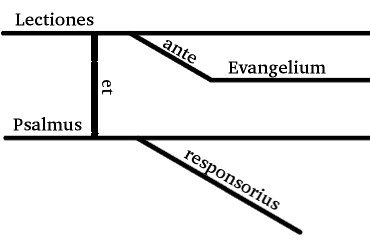
Psalmus is not part of the prepositional phrase beginning with "ante".
It wouldn't make sense to read the phrase as
"readings before (the gospel and the responsorial psalm)"
because only one reading is before both the Gospel and the Responsorial Psalm.
 Sentence_Fragment_Diagram.jpg370 x 241 - 11KThanked by 1PurpleSquirrel
 -
I am just going to be grateful that my choir CAN stand during the psalm and that age doesn't prevent them from doing so.
Thanked by 1PurpleSquirrel -
Appreciate the clarification, Fr.
Got lost in all the parcing and decimation. -
I have long thought that written language needs order of operations symbols.
-
I must say (having a similar opinion) that, of course, there must be some kind of mechanism -- be it never so hard to use -- to indicate, clearly, how the written words' ambiguity should be resolved: a combination of letters and other marks, suitably chosen, might be appropriate. (Or not.)Thanked by 1Adam Wood
-
Sorry, Noel. Don't mean to be a curse. I was just curious.
Charles - Agreed. Therefore, methinks they shall stand until they are unable, or I change my mind. -
You guys are great. My head hurts. Can we sing 'alicubi super iride' responsorially?
-
Sorry, Noel. Don't mean to be a curse. I was just curious.
I should be cursed for failing to write that in PURPLE! It was a joke! Sorry. Will revise right now!
Everyone should have realized what The Weather Channel already knew.
There is no explanation for a Purple Squirrel. -
Oh man... You found me out.
;-)
-
If my choir were singing harmony on the psalm response or some or all of the verses, my preference would be for them to stand.
Fr. Krisman,
I have never understood why the verses in responsorial psalms have been arranged for 4-part harmony when GIRM 61 has always seemed to be straightforward in stating that the verses are to be sung by one person: the psalmist ("Hence the psalmist, or cantor of the Psalm, sings the Psalm verses at the ambo or another suitable place..."). I contrast that statement with GIRM 62 which discusses the Acclamation before the Gospel and explictly mentions the choir ("[The acclamation] is sung by everybody, standing, and is led by the choir or a cantor, being repeated as the case requires. The verse, on the other hand, is sung either by the choir or by a cantor").
Since you mentioned the idea of a choir singing harmony on the verses, I'm hoping that you might know of some documentation that gives the choir the role of singing during the Responsorial Psalm's verses. If so, would you share it? I have been puzzling over this issue for a while. I have rationalized the presence of the 4-part harmony because choirs can sing on the verses when psalms are done as entrance or communion antiphons, but I haven't understood its use during the verses of the Responsorial Psalm itself.
Thanks for your help! -
That kind of reminds me of a question I had this past Lent. Why do all of the psalms sung during Lent have written score for musical accompaniment, if we are to sing them without instruments? Probably a similar answer. The score is there if you want to use one of them in place of a hymn.
-
That kind of reminds me of a question I had this past Lent. Why do all of the psalms sung during Lent have written score for musical accompaniment, if we are to sing them without instruments? Probably a similar answer. The score is there if you want to use one of them in place of a hymn.
More likely because a large majority don't care about trying to go with less instruments during lent like the church requests. Just publishers working the market for those parishes.Thanked by 1Gavin -
Ben:
You cannot blame the publishers. They are printing what the church is buying. At sometime in the past, a priest/bishop told them it was ok to include accompaniments. They would NOT go against the rules without seeking counsel.
Every problem with music in the church is the fault of priests and bishops.Thanked by 1PurpleSquirrel -
Accompanied singing doesn't violate any current OF regulations during Lent. In fact, accompanying singing is ALL the organ can be used for in that season. I had someone tell me once upon a time, that only applied to the organ and other instruments were allowed. A serious discussion followed.
-
@Ignoto, sorry for the two-days’ delay in responding to your important question concerning choirs singing verses of responsorial psalms or adding harmony and/or descants to psalm responses sung by the congregation.
My response is that, as far as I know, the GIRM and other legislative documents dealing with the liturgy contain no norm concerning either of these practices, but a legitimate custom apart from (praeter) the law, or perhaps even contrary (contra) to it, has been established over the course of the 45 years since the Lectionary for Mass was promulgated in 1969. And this custom has been established at least in some parishes in perhaps most dioceses of this country.
The 1983 Code of Canon Law contains the laws on custom (consuetudo) in its canons 23-28:Canon 23 A custom introduced by a community of the faithful has the force of law only if it has been approved by the legislator, in accordance with the following Canons.
Canon 24 §1 No custom which is contrary to divine law can acquire the force of law.
§2 A custom which is contrary to or apart from Canon law, cannot acquire the force of law unless it is reasonable; a custom which is expressly reprobated in the law is not reasonable.
Canon 25 No custom acquires the force of law unless it has been observed, with the intention of introducing a law, by a community capable at least of receiving a law.
Canon 26 Unless it has been specifically approved by the competent legislator, a custom which is contrary to the Canon law currently in force, or is apart from the Canon law, acquires the force of law only when it has been lawfully observed for a period of thirty continuous and complete years. Only a centennial or immemorial custom can prevail over a canonical law which carries a clause forbidding future customs.
Canon 27 Custom is the best interpreter of laws.
Canon 28 Without prejudice to the provisions of Canon 5, a custom, whether contrary to or apart from the law, is revoked by a contrary custom or law. But unless the law makes express mention of them, it does not revoke centennial or immemorial customs, nor does a universal law revoke particular customs.
The “legislator” in these canons would be the diocesan bishop, not the pastor of a parish. And that legislator would not be the supreme legislator (the pope) since the latter is the one who gave us the written law (lex). The legislator either approves the custom which is apart from or contrary to the law, or he does nothing and the practice acquires the force of law after its being observed for a period of 30 continuous and complete years.
After the promulgation of the 1969 Lectionary for Mass, there was a flurry of compositional activity preparing musical settings of the responsorial psalms contained therein. That activity continues to this day. Not all settings were/are just for congregation (the reponses) and psalmist (the verses). Some also involve embellishments by the choir which go beyond their role as members of the congregation and only singing the responses in unison.
In the 10 1/2 years that I directed choirs between 1969 and 1981, the choir would on occasion sing the verses of a responsorial psalm or add harmony/descants on the response. Usually this would occur at a more solemn celebration. It may have been my own composition, or a fauxbourdon setting of verses, or a harmonized Gelineau psalm tone, or one of the through-composed responsorial psalms published by The Composers’ Forum, or one of Alexander Peloquin’s Songs of Israel. Were I leading a choir these days, I certainly would use on occasion the fine responsorial psalms of Fr. Jim Chepponis (several of which are included in Worship IV).
To be fair, I should add that not all interpreters of canon law would agree that these practices of choirs are legitimate customs. I remember that in the mid-1980’s some US bishops expressed the canonical opinion that all liturgical laws were part of the constitutive law of the Church. Accordingly a diocesan bishop would be unable to dispense from any of these laws. As a corollary to that, I suppose they would also have held that customs contrary to the law would be unreasonable and, therefore, prohibited. However, I am unaware of any canonical experts who gave/give that interpretation. (I am also unaware of any diocesan bishop making a statement or promulgating a particular law for his diocese which expressly prohibited a choir’s greater involvement in the singing of responsorial psalms.) Because our rites have been reformed subsequent to VII and things once prohibited are now permitted – even some practices which do not conform to general principles of the reform – it seems to be a stretch to argue that all liturgical laws are constitutive law. -
Fr. Krisman,
Thank you for this helpful response! Singing harmony/descants on the responses had always made sense to me--it was just the choir's participation on the verses that had been confusing.
I can see how the "custom" idea can fit into this context--that makes sense. I am curious, though--if a parish who has had a single psalmist sing the verses for many years recently started encouraging choir members to sing the verses on a psalm, would that still be considered "custom" insofar as it may be a custom for the U.S. church at large (i.e. it doesn't have to be a custom at the individual parish, but may fall under a larger umbrella of "custom")?
Thank you again--this information has given me a lot to think about and has been very helpful. Your contributions to this Forum are greatly appreciated! -
It depends on how "community" in canons 23 and 25 is interpreted. My commentaries on the 1983 Code are in boxes in my garage. Perhaps if someone has access to the CLSA commentary or another, they can shed some light on your question. Otherwise, I'll start going through my boxes later this afternoon.
-
Wow.
Like, seriously, wow. -
IIRC, a parish is not a juridical entity that can establish a custom with the force of law behind it. It has to be a diocese or prelature or religous order (perhaps certain abbeys that have a higher juridical status as well), et cet.
-
Before Fr. Krisman starts digging out his commentaries on the Code, let it be known that the CLSA has been a non-Catholic agitation group for many years -- I ran foul of them in Graduate School, and that's 20 years ago. I'm willing to believe that the group has changed, but I would need to see evidence.
Otherwise, the CLSA's commentary will read like Chestertonian satire.


Welcome to the MusicaSacra Forum!
To participate in the discussions on Catholic church music, sign in or register as a forum member, The forum is a project of the Church Music Association of America.
Categories
- All Discussions21,096
- General Music Discussion8,211
- Job Openings197
- Management of Music Programs850
- Choral Matters532
- Church Documents and Rubrics524
- CMAA Notes301
- Events716
- For Newcomers: Read First26
- Sacred Polyphony546
- Hymnody872
- Gregorian Chant: General2,697
- ↳ Graduale Romanum and Liber Usualis368
- ↳ Graduale Simplex60
- ↳ Semiology63
- Vernacular Plainsong696
- Anglican Use and Anglican Chant68
- Organ, Other Instruments and Repertoire435
- New Composition/Works in Progress1,290
- Recordings230
- Music for Hispanic Ministry159
- Music Education: Children211
- Music Education: General222
- News Items245
- Positions Wanted2
- General Discussion: Catholicism739
- Amusements177
- General Discussion1,033
- Opinions117